


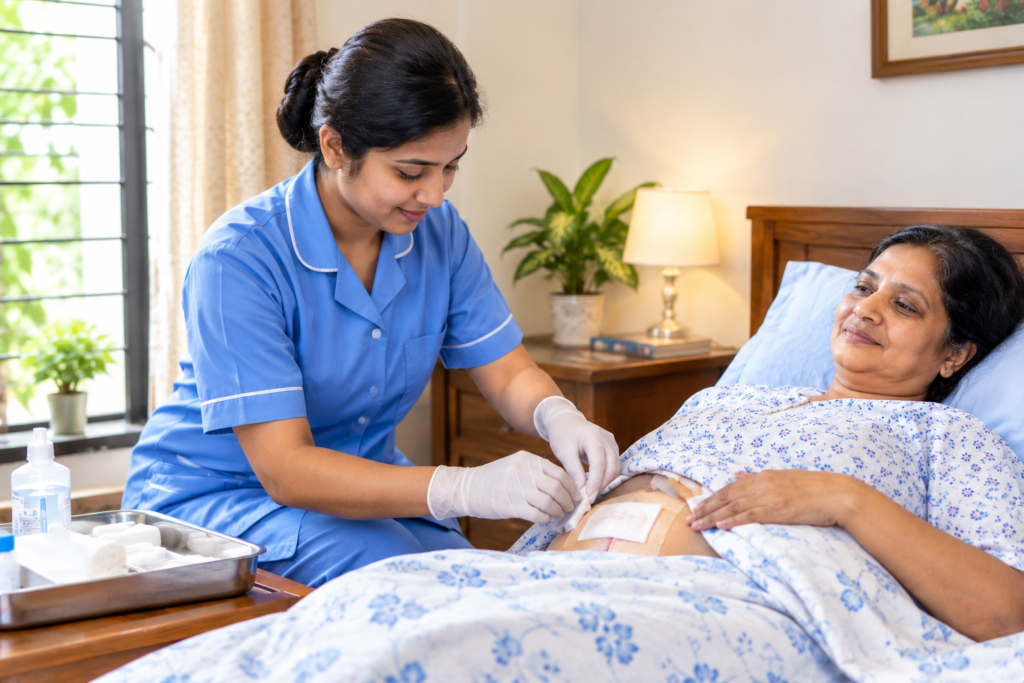
The day a hospital discharges a patient often brings relief, followed quickly by worry. The surgery is over, but recovery has only begun. In Dhaka, where traffic, distance, and crowded hospitals make repeated visits tiring, many families therefore choose post surgery care at home in Dhaka so the patient can recover in a familiar, comfortable environment.
This guide explains what post operative care at home involves, who needs it, what services to expect, how to prepare your home, and which warning signs need urgent attention. Please note that it is general educational information. It does not replace the advice of your surgeon or treating doctor.
Why Is Post-Operative Care Important After Hospital Discharge?
Hospitals manage the surgery and the first days of recovery. After discharge, however, the responsibility shifts to the patient and family. This stage matters for several reasons:
- Wounds need clean, correct care. For example, poor dressing technique can increase the risk of infection.
- Medicines must follow a strict schedule. Missed doses of antibiotics, painkillers, or blood thinners can affect recovery.
- Early complications are easier to manage when you notice them early. Therefore, report fever, swelling, or unusual discharge promptly.
- Movement must stay safe. Moving too little, too much, or in the wrong way can cause problems.
- Families need support. Caring for a recovering patient is physically and emotionally demanding.
Infection is one of the main concerns. The World Health Organization notes that bacteria entering through the surgical incision cause surgical site infections, and that in low- and middle-income countries about 11% of surgical patients develop one. Structured post hospitalization care helps families follow the surgeon’s instructions consistently. Still, no home care arrangement can guarantee a particular recovery outcome, since healing depends on the patient’s age, health, type of surgery, and adherence to medical advice.
Who Needs Post Surgery Care at Home?
Not every patient needs professional help. Nevertheless, support is worth considering for:
- Elderly patients who live with limited mobility or chronic illness
- Patients who are bedridden or have restricted movement
- Patients with surgical wounds, drains, catheters, or feeding tubes
- Patients on injectable medicines or complex medication schedules
- Patients with diabetes, hypertension, heart disease, or kidney disease
- New mothers recovering from a cesarean section
- Families where everyone works and no one can stay with the patient during the day
- Families living far from the hospital who want to reduce repeated travel
Common Types of Surgery That May Require Home Care
Recovery needs differ by procedure. In every case, the surgeon’s discharge plan takes priority.
Orthopedic Surgery
Hip, knee, spine, and fracture surgeries often limit movement for weeks. Patients may need help with safe transfers, positioning, walking aids, and prescribed exercises. Fall prevention is especially important for elderly patients. Moreover, reduced movement after major orthopedic surgery raises the risk of blood clots, so follow the doctor’s advice on mobility and medication closely (see the warning signs section below).
Abdominal Surgery
After gallbladder, hernia, appendix, or bowel surgery, patients may need wound care, dietary guidance as instructed, pain monitoring, and help getting out of bed without straining the incision.
Cardiac Surgery
Heart surgery recovery usually involves close monitoring of vital signs, strict medication schedules, and carefully supervised activity. Meanwhile, any chest pain or breathing difficulty requires urgent medical attention.
Cesarean Section (C-Section)
Mothers need support with incision care, rest, movement, and newborn care while they recover. In this situation, home care can ease the load on family members.
Neurological Surgery
Brain and spine procedures may leave patients with weakness, limited mobility, or altered alertness. As a result, these patients often need close observation, positioning support, and help with daily activities.
What Services Are Included in Post Surgery Home Care?
Services vary by provider and by the patient’s medical needs. Typically, recovery care at home may include the following.
Home Nursing Care After Surgery
A nurse who carries out clinical tasks according to the doctor’s instructions and observes the patient for changes provides home nursing care after surgery. This type of nursing care is especially relevant when a patient has wounds, injections, or medical devices.
Surgical Wound Dressing and Incision CareINSERT-URL
An appropriately qualified healthcare professional should handle surgical wound dressing at home, using clean technique and the materials the doctor advises. Hand hygiene comes first in every dressing change, and the WHO publishes a guide on hand hygiene in home-based care that nurses and trained caregivers can follow. In addition, families should not remove stitches, apply unprescribed creams, or change dressings on complex wounds without guidance.
Medication and Follow-Up Support
Support may include reminders to take medicines as prescribed, observation for side effects, and help keeping track of follow-up appointments, test dates, and reports. Above all, nurses and caregivers should never change doses on their own.
Personal Hygiene and Bathing Assistance
At first, many patients cannot bathe, use the toilet, or change clothes independently. Help with sponge bathing, oral care, grooming, and toileting protects dignity and reduces infection risk, as long as the caregiver follows the surgeon’s instructions on keeping the wound dry.
Mobility and Positioning Assistance
Regular repositioning helps prevent pressure sores in bedridden patients. Likewise, assistance with sitting up, standing, and walking, as the doctor permits, supports safe movement.
Feeding and Daily Activity Support
This includes preparing and serving meals according to the doctor’s or dietitian’s advice, encouraging fluids where allowed, and assisting with eating when the patient is weak.
Vital Signs Monitoring
Checking temperature, pulse, blood pressure, oxygen level, and blood sugar (when relevant) helps identify changes early, so the family can inform the doctor promptly.
Catheter and Feeding Tube Care, When Required
Urinary catheters, feeding tubes, and drains require trained handling. Therefore, qualified healthcare professionals should perform these procedures according to medical instructions, and untrained helpers should not attempt them.
Nurse vs. Caregiver: Which One Does a Patient Need?
Families often use the terms interchangeably, but the roles differ.
| Home Care Nurse | Patient Caregiver | |
|---|---|---|
| Focus | Clinical and medical tasks | Daily living support |
| Typical tasks | Wound dressing, injections, catheter or tube care, vital signs, medication administration as directed | Bathing, feeding, toileting, mobility help, companionship, hygiene |
| Best suited for | Patients with wounds, devices, or complex medical needs | Stable patients who need help with daily activities |
In fact, many patients benefit from a combination: a home care nurse in Dhaka for clinical tasks and a patient caregiver service in Dhaka for round-the-clock daily assistance. Ask the surgeon or treating doctor which level of care suits the patient, and then discuss the patient’s needs openly with the service provider.
Benefits of Choosing Post Surgery Care at Home in Dhaka
- Comfort and familiarity. Recovering among family can support emotional wellbeing.
- Less travel. Dhaka’s traffic can make hospital trips exhausting for a patient in pain.
- One-to-one attention. Home care offers focused attention that busy hospital wards may not provide.
- Lower exposure to hospital-acquired infections for patients who are medically stable enough to go home.
- Family involvement. Relatives can learn correct care methods from professionals.
- Flexible arrangements. Depending on provider availability, families can arrange daytime, nighttime, or longer periods of care.
How to Prepare Your Home Before a Patient Returns from Hospital
Preparation reduces stress on the first day. Start with these steps:
- Set up a clean, well-ventilated recovery room, preferably close to a bathroom.
- Arrange a comfortable bed at a suitable height. Also, ask the doctor whether a hospital-type bed or special mattress is advisable.
- Remove trip hazards such as loose rugs, cables, and clutter.
- Check the lighting, including at night, especially for elderly patients.
- Keep a medicine chart and choose a safe place for medicines.
- Keep emergency numbers handy, including the surgeon, the hospital, and the nearest emergency service.
- Gather essentials: clean linen, towels, gloves, dressing supplies if the doctor advises them, a thermometer, and a blood pressure monitor.
- Plan transport for follow-up visits, including a safe way to get the patient up stairs if the home has no lift.
- Finally, collect all discharge papers, prescriptions, and reports in one folder.
Essential Post-Surgery Care Tips for Family Members
- Follow the discharge summary closely. The treating team sets the diet, activity limits, wound care, and medication timing.
- Wash hands before touching the patient or the wound. The WHO’s hand hygiene guidance for home-based care explains when and how.
- Keep dressings clean and dry unless the doctor says otherwise.
- Do not skip follow-up visits, even if the patient feels better.
- Encourage gentle movement only as the doctor permits.
- Watch pain levels and report pain that is increasing instead of easing.
- Support nutrition and hydration within the doctor’s advice.
- Be mindful of emotional health. Anxiety, low mood, and sleep problems are common after surgery.
- Avoid home remedies or leftover medicines unless the doctor approves them.
- Look after yourself. Caregiver burnout is real, so share duties and accept professional help when needed.
Warning Signs After Surgery: When to Contact a Doctor
Contact the surgeon or treating doctor promptly if you notice:
- Fever or chills
- Redness around the wound that is spreading or worsening
- Increasing swelling, warmth, or pain at the incision
- Pus, foul-smelling discharge, or the wound opening
- Persistent vomiting or inability to keep fluids down
- Reduced or no urine, or severe constipation that the doctor has flagged
- Swelling, pain, or redness in one leg, especially the calf. These can be symptoms of deep vein thrombosis (DVT), a blood clot that can develop weeks after surgery
Seek emergency medical care immediately for:
- Difficulty breathing or sudden shortness of breath
- Chest pain
- Uncontrolled bleeding
- Fainting, confusion, or sudden weakness
- Sudden deterioration or a patient who is hard to wake
When in doubt, call the doctor or go to the nearest emergency department. Do not wait for the next scheduled visit.
How to Choose a Reliable Post Surgery Care Service in Dhaka
Choosing a post surgery care service in Dhaka is a significant decision. Therefore, consider the following:
- Ask about staff qualifications. Request details on the training and experience of the nurse or caregiver who will care for your patient.
- Confirm the service scope. Clarify what the nurse or caregiver will and will not do.
- Discuss the care plan. A good provider listens to the patient’s needs and works around the doctor’s instructions.
- Ask how the provider verifies and supervises staff.
- Check availability. Confirm day, night, and 24-hour options in your area of Dhaka.
- Get pricing in writing. Ask what affects the cost, such as the patient’s condition, duty hours, and level of care, and confirm what the price includes and excludes.
- Ask about communication. Find out how updates reach the family and how the provider handles emergencies.
- Read about the provider independently, and speak to other families if possible.
Why Consider Maisha Care for Post Surgery Care at Home?
At Maisha Care, we focus on helping families arrange suitable patient care at home in Bangladesh, including home nursing and caregiver support for patients recovering after surgery. Because every patient’s situation is different, we encourage families to contact us to talk through the surgery, the doctor’s discharge instructions, the level of support needed, and the practical arrangements for their home in Dhaka.
For this reason, we recommend confirming availability, service options, and arrangements directly with our team. That way, the plan fits the patient’s actual needs instead of a one-size-fits-all package.
Frequently Asked Questions (FAQ)
What is included in post surgery care at home?
It typically includes monitoring vital signs, medication support, wound care by qualified professionals, hygiene help, mobility assistance, and feeding support. However, the exact scope depends on the surgery, the doctor’s instructions, and the provider.
How long does a patient need home nursing care after surgery?
It varies widely. Some patients need support for a few days, while others need weeks or longer, particularly elderly or bedridden patients. The surgeon or treating doctor can best advise on the expected recovery period.
Can a caregiver provide post-operative care?
A caregiver can help with daily living tasks such as bathing, feeding, and mobility support. However, a qualified nurse or other healthcare professional should handle clinical tasks like wound dressing, injections, and catheter care according to medical instructions.
When should I hire a nurse after hospital discharge?
Consider a nurse if the patient has a surgical wound, drain, catheter, or feeding tube, needs injections, or has several medical conditions. Likewise, hire one if the family feels unsure about managing care safely. As a first step, ask the hospital team at discharge.
Is 24-hour post surgery care available in Dhaka?
Home care providers in Dhaka commonly offer round-the-clock care, but availability varies. Please contact Maisha Care directly to confirm current options for your area and patient needs.
What factors affect the cost of post surgery care at home in Dhaka?
Cost generally depends on the type of professional required (nurse or caregiver), duty hours (day, night, or 24 hours), the duration of care, the patient’s medical complexity, any supplies needed, and location. Before you start, ask for a clear written estimate.
Can patients receive wound dressing services at home?
Yes, in many cases. A qualified healthcare professional can perform surgical wound dressing at home by following the surgeon’s instructions. In contrast, families should not attempt complex dressings on their own.
Conclusion and Call to Action
Good post surgery care at home in Dhaka combines the right professional support, a prepared home, attentive family members, and close adherence to the surgeon’s instructions. Moreover, knowing the warning signs and acting early can make a real difference to safety during recovery.
If you are planning post hospitalization care for a loved one, we invite you to contact Maisha Care to discuss suitable home care arrangements. Share the patient’s condition and discharge instructions, and we will help you understand the options available.
This article is for general educational purposes only and is not personalized medical advice. Always follow the instructions of your surgeon or treating doctor.
