


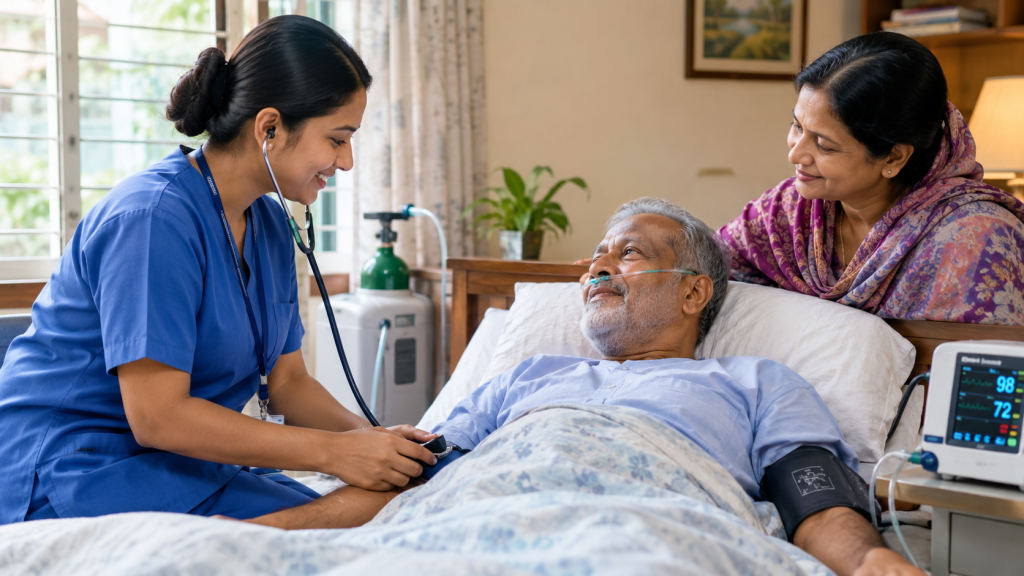
An ICU patient home care service in Dhaka can support patients who return home after a serious illness or extended hospital stay but still need close attention. They may require oxygen support, scheduled medicines, regular blood pressure and oxygen-level checks, mobility assistance, or help with daily activities.
For families, bringing a loved one home can be both comforting and challenging. Professional home nursing and post-ICU care can help families manage these ongoing needs while supporting the patient’s comfort and recovery.
This guide explains when ICU or post-ICU home care may be needed, what services and equipment can be useful, and how to choose a suitable home healthcare provider in Dhaka.
What Is ICU Patient Home Care?
ICU patient home care provides professional nursing and healthcare support to patients who have left the intensive care unit or hospital but still require close attention and skilled assistance at home. You may also hear terms such as post-ICU care at home, home ICU care, critical patient home care, or ICU nursing service at home.
However, home ICU care does not recreate a hospital intensive care unit inside a patient’s home. More importantly, it cannot replace hospital treatment when a patient’s condition becomes unstable or requires continuous specialist intervention.
Instead, doctors may recommend home care when a patient has become stable enough to leave the hospital but still needs professional support during recovery. In such situations, trained nurses, caregivers, medical equipment, and regular communication with the treating doctor can help the family manage the patient’s daily care more effectively.
For example, a patient may return home with a doctor’s care plan that includes oxygen support, regular vital-sign monitoring, prescribed medicines, wound care, feeding assistance, or help with mobility. A trained healthcare professional can then follow the prescribed care routine and alert the family or doctor when the patient’s condition changes.
How Does ICU Home Care Differ From Ordinary Caregiver Service?
A regular caregiver primarily helps patients with daily activities. For example, caregivers may assist with bathing, feeding, changing clothes, moving around the home, maintaining personal hygiene, and providing companionship.
A qualified nurse, on the other hand, can provide a higher level of clinical support within their professional scope. For instance, a nurse can monitor vital signs, administer medicines according to the doctor’s prescription, provide wound or catheter care when trained and instructed to do so, and identify changes that require medical attention.
Therefore, some patients may benefit from both services. A caregiver can support everyday activities, while a qualified nurse can handle appropriate clinical care.
Most importantly, a caregiver cannot replace a qualified nurse when a patient needs nursing care. Similarly, a nurse cannot replace a doctor or hospital-based emergency treatment when the patient’s condition becomes critical.
As a result, families should first understand the patient’s medical needs and then choose the appropriate level of home care with guidance from the treating physician.
When Does a Patient Need ICU Home Care in Dhaka?
There is no single rule. The treating doctor or another qualified healthcare professional should assess the patient and advise on the right level of support. Families commonly look for ICU nursing service in Dhaka in situations like these:
- Post-ICU recovery: The patient is weak and needs regular monitoring. Many ICU survivors also face lingering weakness, memory, or mood changes, often called post-intensive care syndrome.
- Post-surgery recovery: Major surgery may need wound care, medically directed pain management, and help with movement.
- Oxygen support: The patient needs supplemental oxygen and someone who can monitor it safely.
- Limited mobility: Stroke, fractures, or long illness can leave a patient bedridden.
- Elderly patients needing close observation: Older adults can change quickly. The WHO’s ageing and health fact sheet gives useful background.
- Feeding dependence: Some patients need help with oral or doctor-prescribed tube feeding.
- Complex medication schedules: Several medicines and regular vital-sign checks are hard to manage without training.
- No capable caregiver at home: Relatives may have jobs, young children, or live far away.
A patient who is unstable, in respiratory distress, or needs continuous advanced life support may need to stay in, or return to, hospital. If you are unsure, ask the discharging doctor whether home care is appropriate.
What Services Are Included in ICU Patient Home Care?
Services depend on the patient’s condition, the doctor’s instructions, and the provider’s capabilities. Not every provider offers everything below, so confirm in advance.
- Professional home nursing: Trained nurses provide skilled care and observation. This is the core of any home nursing service in Dhaka for serious conditions.
- Vital signs monitoring: Regular checks of blood pressure, pulse, temperature, breathing rate, and oxygen saturation, recorded for the doctor.
- Medication support: Giving or assisting with medicines exactly as prescribed.
- Oxygen support and monitoring: Observing the patient on oxygen therapy and reporting concerns promptly.
- Feeding assistance: Help with meals, hydration, and doctor-directed feeding methods.
- Wound and dressing care: Clean dressing changes and watching for signs of infection.
- Catheter care: Hygiene and observation for patients with urinary catheters.
- Bedridden patient care at home: Safe handling and daily comfort for patients who cannot leave the bed.
- Position changing and pressure sore prevention: Regular repositioning and skin checks (see the NHS guide to pressure sores).
- Personal hygiene assistance: Bathing, oral care, and toileting support with dignity.
- Mobility and transfer support: Safe movement between bed, chair, and wheelchair.
- Post-hospital recovery support: Following the discharge plan and any exercises a physician or physiotherapist advises. Families who mainly need hospital patient care help after discharge can ask about it separately.
- Communication with family: Clear updates about routine care and when to call the doctor.
ICU Equipment That May Be Needed at Home
Equipment needs vary widely. Some patients need only a hospital bed and a pulse oximeter, while others need more advanced devices. Use equipment only when medically appropriate, and never change a device’s settings unless a doctor or trained professional has told you to.
- Hospital bed: An adjustable bed that makes positioning, feeding, and nursing care safer.
- Oxygen concentrator: Supplies oxygen from room air (oxygen concentrator rent in Dhaka), commonly prescribed for long-term oxygen needs.
- Oxygen cylinder: Often kept as a backup (oxygen cylinder rent), especially given possible power cuts.
- Patient monitor: Tracks vital signs where advised.
- Pulse oximeter: Measures oxygen saturation and pulse.
- Suction machine: Clears secretions for certain patients under trained supervision.
- Nebulizer: Delivers prescribed inhaled medication.
- BiPAP/CPAP machine: Breathing support that must be prescribed and set by a doctor.
- Wheelchair: For safer movement once the patient can sit up.
- Other prescribed equipment: Air mattresses, feeding pumps, or commode chairs.
In Dhaka, many families rent medical equipment instead of buying it, which can suit short recoveries. Either way, ask who will deliver, set up, and service it, and what happens if a device fails at night.
Benefits of Professional ICU Patient Home Care in Dhaka
Professional support cannot guarantee any medical outcome, but it can make recovery more manageable.
- A familiar environment. Many patients, especially older adults, feel calmer in their own room.
- Continuous professional support. Trained staff can notice changes and follow the doctor’s instructions consistently.
- Less burden on family caregivers. Caring for a critically ill relative is draining, and research on post-intensive care syndrome in families describes the anxiety, stress, and fatigue relatives may feel.
- Easier daily care. Turning, bathing, feeding, and medicines follow an organised routine.
- Support for elderly and dependent patients. Many older parents in Dhaka live with limited family support.
- Convenience across the city. Traffic can turn a hospital trip into a half-day ordeal, and care at home reduces avoidable transport.
ICU Home Care vs Regular Caregiver Service
Families often ask whether a caregiver is enough. It depends on the patient’s medical needs.
| Factor | ICU / Post-ICU Home Nursing Care | Regular Caregiver Service |
| Level of medical support | Skilled clinical care under a doctor’s instructions | Non-medical help with daily activities |
| Staff expertise | Qualified nurses, often with hospital experience | Trained attendants, usually without clinical qualifications |
| Patient monitoring | Regular vital-sign checks and record keeping | General observation, reporting concerns to family |
| Medication support | Administering prescribed medicines as the doctor directs | Reminding or assisting with simple medicines |
| Equipment requirements | May involve oxygen, monitors, or suction | Usually minimal, such as a wheelchair |
| Suitable conditions | Post-ICU, post-surgery, oxygen-dependent, bedridden patients | Elderly or stable patients needing daily help |
A caregiver is a valuable part of a care team, but not a substitute for a doctor or qualified nurse when clinical care is needed. Many families use a nurse for medical tasks and a caregiver for daily support, particularly with 24 hour home nursing arrangements.
How to Choose the Best ICU Patient Home Care Service in Dhaka
Rather than hunting for “the best,” look for evidence that a provider is capable, transparent, and safe.
- Qualified staff. Ask about training, certification, and registration with the Bangladesh Nursing and Midwifery Council where applicable.
- Relevant experience. Caring for post-ICU patients differs from routine elderly care.
- Shift options. Check for 12-hour or 24-hour support and how handovers work.
- Emergency process. Know who to call and when the patient would go to hospital.
- Staff verification. Ask for identity checks, background verification, and references.
- Clear terms and pricing. Written terms prevent misunderstandings.
- Equipment access. Ask whether the provider can arrange a hospital bed or oxygen concentrator.
- Doctor coordination. The provider should follow the physician’s care plan.
- Speak with past clients, and be cautious of exaggerated promises.
- Good providers keep care notes, vital-sign records, and medication logs.
Be wary of anyone who guarantees recovery or claims to offer “complete ICU” at home without a doctor’s involvement.
How Much Does ICU Patient Home Care Cost in Dhaka?
There is no single price, and a provider who quotes a fixed rate without understanding the patient’s condition deserves extra questions. Costs generally depend on:
- Hours of care needed each day
- 12-hour versus 24-hour coverage
- Nurse versus caregiver
- The patient’s condition and complexity
- Equipment, rented or bought
- Number of visits, if care is visit-based
- Any specialised nursing requirements
Ask for a written estimate showing what is included and what is charged separately. Comparing two or three providers against the same care needs is more useful than comparing headline prices.
Areas We Serve in Dhaka
Patients needing home care live across the whole city. Families in Gulshan, Banani, and Baridhara often arrange care for elderly parents while they work or live abroad. In Uttara and Bashundhara, many newer households need support after a relative leaves a nearby hospital.
Dhanmondi, Mohammadpur, and Mirpur have many senior citizens who benefit from regular nursing visits. Badda, Khilgaon, Motijheel, and nearby areas are also commonly covered, though response time varies with traffic. Always confirm that your address is served and whether night shifts are possible.
Questions to Ask Before Hiring ICU Home Care
- Is the caregiver or nurse professionally trained? Ask for qualifications.
- Is 12-hour or 24-hour care available? Confirm backup staff.
- Can the provider support post-ICU patients? Ask about similar cases.
- What equipment is available? Find out how quickly it can be arranged.
- How are emergencies handled? Ask about escalation and hospital transfer.
- Can the service coordinate with the patient’s doctor? Care should follow the physician’s plan.
- What are the service charges? Request a written breakdown.
- Can the care plan be adjusted? Needs change as the patient recovers or worsens.
Frequently Asked Questions
What is ICU patient home care service in Dhaka?
It provides trained nurses, caregivers, and, where appropriate, medical equipment to support patients at home after ICU or hospital treatment, under the treating doctor’s guidance.
Can an ICU patient be cared for at home?
Some patients can, once their doctor confirms they are stable and the home is suitable. Unstable patients may need to stay in hospital.
How long does a patient need home ICU care?
There is no fixed period. It depends on the illness, the speed of recovery, and the doctor’s advice.
Is a nurse required for ICU patients at home?
When clinical needs such as oxygen therapy, injections, wound care, or catheters are involved, a qualified nurse is usually recommended. Your doctor can advise.
What equipment may be required for ICU home care?
Common items include a hospital bed, oxygen concentrator, pulse oximeter, nebulizer, and suction machine. Monitors or BiPAP/CPAP devices should only be used on medical advice.
How much does ICU home care cost in Dhaka?
Cost depends on hours of care, nurse versus caregiver, the patient’s condition, and equipment. Ask for a written quotation.
Is 24-hour ICU home care available in Dhaka?
Many providers offer 12-hour and 24-hour nursing, but availability depends on the provider, your area, and the patient’s condition.
How do I choose a reliable home healthcare provider in Dhaka?
Check staff qualifications, experience with critically ill patients, emergency procedures, staff verification, and pricing transparency. Ask for references.
Making an Informed Decision
Bringing a seriously ill family member home is both a relief and a responsibility. The right ICU patient home care service in Dhaka should fit your patient’s medical needs, your doctor’s instructions, and your family’s real circumstances, from traffic and work schedules to who is available at home.
Start with the discharge plan, ask the treating doctor what level of care is needed, then compare providers on qualifications, communication, equipment support, and transparency. Home care supports recovery, but it does not replace hospital treatment if the patient’s condition worsens.
If you are arranging care for a parent or relative, consider speaking with a qualified home healthcare provider, such as Maisha Care or Patient Care Home BD, about the patient’s specific requirements. A calm, detailed conversation can help you understand your options before you decide.
